Wake
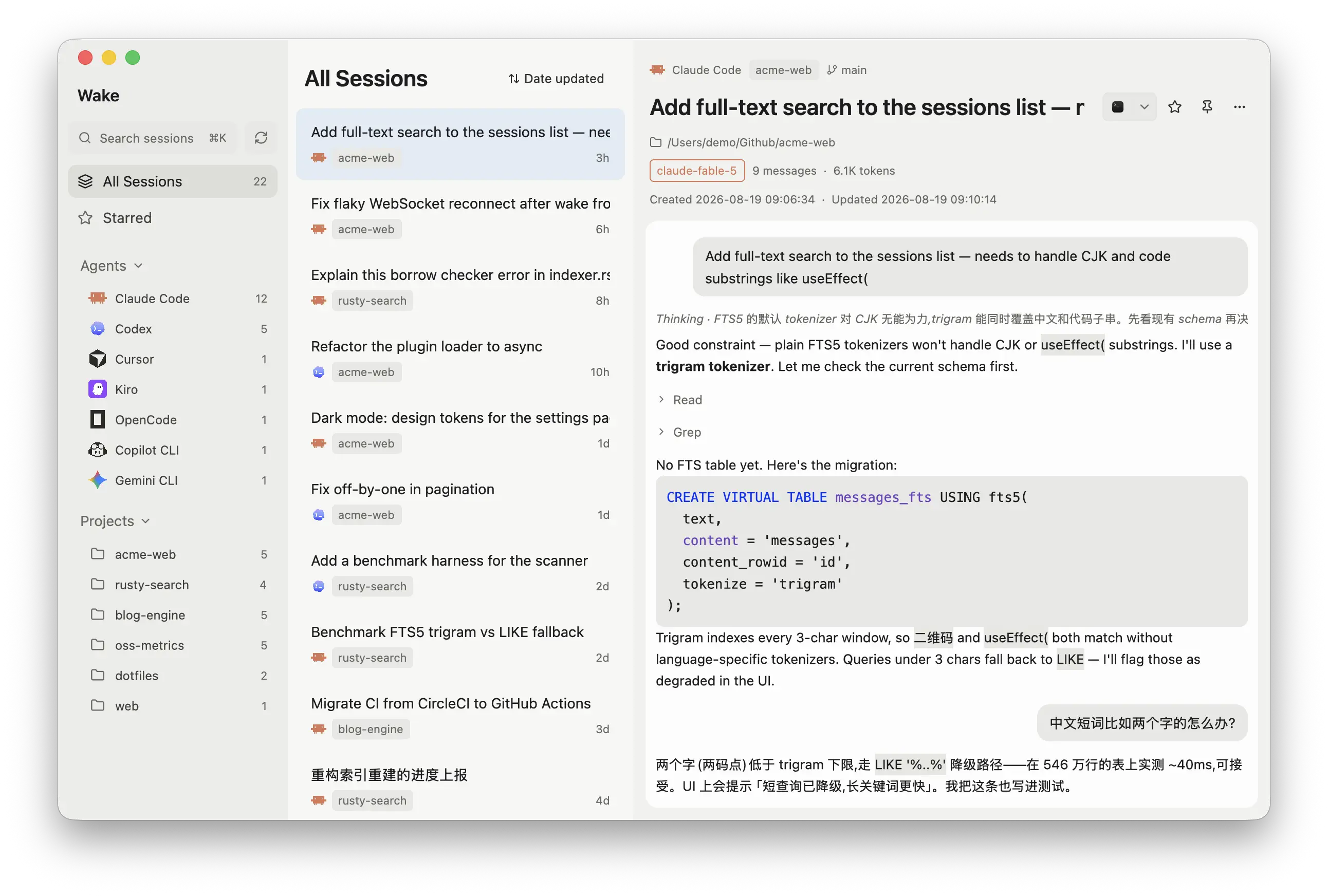
A native desktop app that gathers every coding-agent session on your machine into one place — find any conversation in seconds, read it in full, and pick it back up in your terminal. Built with Rust + GPUI. macOS first; Linux and Windows are experimental.
Your agent history is scattered across ~/.claude, ~/.codex and many other folders. Wake reads all of it, read-only and entirely on your machine. And with the Wake plugin, every new Claude Code or Codex session starts knowing where your agents left off.
Website: wake.cool — downloads, the MCP and CLI docs, and the changelog (中文).
Features
- Pick up where any agent left off — every new Claude Code or Codex session starts knowing where your agents left off in the project, and can read any earlier session. Install the plugin
- One place for every session — grouped by agent and project, sub-agents under their parent, updated live as your agents write
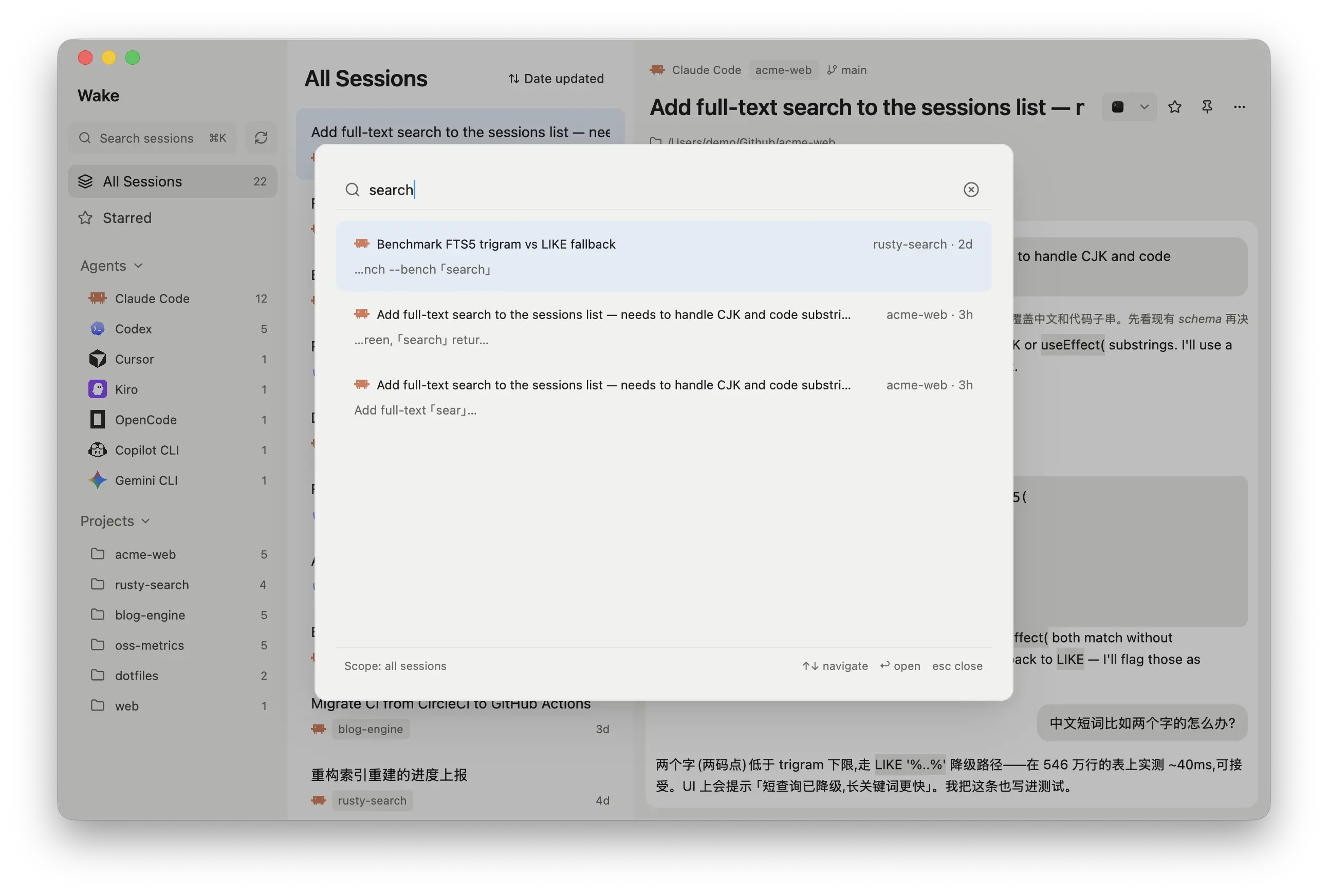
- Full-text search (⌘K / Ctrl+K) — every title and transcript, CJK and code (
useEffect() included; jumps straight to the match - Transcript view — chat bubbles, inline images, collapsible tool calls, thinking, syntax highlighting
- One-click resume — back in your terminal (Terminal, iTerm, Warp, Ghostty, Kooky…) or in Claude / Codex Desktop, in the right project folder
- Manage — star, pin, export to Markdown, hand a session to another agent, delete to the Trash
- Clean up — find the sessions eating your disk and clear them out in one go
- Memory — the notes and instruction files your agents keep (
CLAUDE.md,AGENTS.md, auto-memory, Cursor rules, …), by agent and project - Insights — activity heatmap, streaks, weekly trends, and your top agents, projects and models
- Remote hosts — mirror the sessions on your other machines over SSH
- MCP and CLI —
wake-mcpandwake-clilet any agent search your history and read transcripts
Supported agents
| Agent | Data source | Model | Via |
|---|---|---|---|
| Claude Code | ~/.claude/projects/**/*.jsonl |
✅ | — |
| Codex CLI | ~/.codex/sessions + state_5.sqlite |
✅ | ✅ |
| Qoder CLI | ~/.qoder/projects/*/*.jsonl |
✅ | — |
| Copilot CLI | ~/.copilot/session-store.db |
— | — |
| Cursor | ~/.cursor/projects/**/agent-transcripts + Cursor's state.vscdb (IDE chats) |
✅ | — |
| OpenCode | ~/.local/share/opencode/opencode.db |
✅ | — |
OpenCode 2 (opencode2) |
~/.local/share/opencode/{opencode.db,opencode-next.db} |
✅ | — |
| Kiro | ~/.kiro/sessions/cli |
✅ | — |
| Gemini CLI | ~/.gemini/tmp/**/chats |
— | — |
| Pi | ~/.pi/agent/sessions/**/*.jsonl |
✅ | — |
| Oh My Pi | ~/.omp/agent/sessions/**/*.jsonl |
✅ | — |
| Grok Build | ~/.grok/sessions/**/updates.jsonl |
✅ | — |
| Kimi Code | ~/.kimi-code/sessions/**/wire.jsonl |
— | — |
| Antigravity | ~/.gemini/antigravity/brain, ~/.gemini/antigravity-ide/brain + ~/.gemini/antigravity-cli/conversation_summaries.db |
✅ | ✅ |
DeepSeek Harness (dsh) |
~/.dsh/sessions/**/session*.jsonl[.zstd] |
✅ | — |
| Hermes Agent | ~/.hermes/state.db + profiles/*/state.db |
✅ | ✅ |
| OpenClaw | ~/.openclaw/agents/*/agent/openclaw-agent.sqlite + agents/*/sessions/*.jsonl |
✅ | ✅ |
| CodeBuddy | ~/.codebuddy/projects/*/*.jsonl |
✅ | — |
| WorkBuddy | ~/.workbuddy/projects/*/*.jsonl |
✅ | — |
| ZCode | ~/.zcode/cli/db/db.sqlite |
✅ | — |
| Craft Agents | ~/.craft-agent/workspaces/*/sessions/*/session.jsonl |
✅ | ✅ |
| Devin | ~/.local/share/devin/cli/sessions.db |
✅ | — |
| Kilo Code | ~/.local/share/kilo/kilo.db + the legacy extension's globalStorage/kilocode.kilo-code/tasks |
✅ | ✅ |
| Grok Bot | the desktop app's cache (Grok Bot/sand-client-persistence) |
— | — |
Agents' own environment variables (CODEX_HOME, XDG_DATA_HOME, …) are respected, and Settings → Session locations adds folders anywhere else.
Model: Wake shows the LLM a session used. Via: Wake shows where it started (CLI, IDE, desktop app, chat channel). "—" means the agent doesn't record it.
- Codex — background threads (auto-review,
/review, compaction) are skipped;spawn_agentsub-agents are listed under their parent - Cursor — chats are read from transcripts, or from Cursor's own database when there is no transcript
- Craft Agents — on a Claude connection, Wake shows the Craft session and hides the duplicate Claude Code copy
- Kilo Code — the new extension, CLI and JetBrains plugin share
kilo.db; tasks from the legacy extension are listed too - Grok Bot — conversations live in Grok Bot's cloud; Wake reads the latest messages the desktop app keeps on this computer, a conversation it no longer keeps stays listed with its last message, and deleting one in Wake only hides it
Not supported: Windsurf and Trae (encrypted), Amp, Factory and Warp (cloud only).
Remote hosts
Add a machine in Settings → Remote hosts (an ~/.ssh/config alias or user@host) and its sessions show up next to yours with an @host badge, searchable and resumable through a copied ssh -t command. Wake syncs on launch, on refresh and on Sync now.
- SSH has to work without prompts: your key loaded in an agent, the host key already trusted
rsyncis needed on both ends; on Windows, takersyncandsshfrom the same Cygwin/cwRsync install and put it ahead of Windows OpenSSH inPATH(why)- Only session data is copied, never credentials, and nothing on the remote is ever written
- Remotes are assumed to use default paths; Windows remotes aren't supported
Connect your agents
Claude Code and Codex plugins
Every new session starts knowing where your agents left off in this project, and can open any earlier session through Wake's MCP tools.
claude plugin marketplace add iAmCorey/Wake --sparse .claude-plugin plugins/wake && claude plugin install wake@wake
codex plugin marketplace add iAmCorey/Wake --sparse .agents/plugins --sparse plugins/wake && codex plugin add wake@wake
Needs Wake 0.9 or later, opened at least once. In Codex, trust the hook in /hooks. More in docs/cli.md.
MCP server
wake-mcp ships with the app and gives any MCP client five read-only tools:
| Tool | What it does |
|---|---|
wake_search |
Search every session and memory file |
wake_list_sessions |
Recent sessions, by project, agent, time or starred |
wake_get_session |
Read a transcript or memory file, page by page |
wake_list_projects |
Projects with sessions, most recent first |
wake_list_memories |
Your agents' memory and instruction files, by project |
Copy the setup from Settings → Connect, or:
claude mcp add --scope user wake -- "/Applications/Wake.app/Contents/MacOS/wake-mcp"
# ~/.codex/config.toml
[mcp_servers.wake]
command = "/Applications/Wake.app/Contents/MacOS/wake-mcp"
Full reference: docs/mcp.md.
From a shell
wake-cli gives the same answers in a terminal (Settings → Connect has the command to put it on your PATH):
wake-cli sessions --project "$PWD" --limit 5      # what happened in this repo
wake-cli search "rate limiter" --project "$PWD"   # where was this discussed
wake-cli show 'claude-code:1b2c3d4e-…'            # read that transcript
wake-cli context                                  # what a new session here starts with
wake-cli refresh                                  # update the index while Wake is closed
npx skills add iAmCorey/Wake teaches agents to reach for it. Full reference: docs/cli.md.
Zoom
Make everything bigger — 110%, 125% or 150% — with ⌘+ / ⌘− / ⌘0 (Ctrl on Linux and Windows), the View menu, or Settings → Appearance.
Language
Wake follows your system language, with Simplified Chinese built in (Settings → General → Language). A new language is one JSON file, and partial translations are welcome: see crates/wake/locales/README.md.
Privacy stance
- Agent data is opened read-only; Wake never writes to another tool's files
- Credential files (
auth.jsonand friends) are never read - No background network requests: just a manual update check, plus SSH/rsync to remote hosts you add
- Wake's index (
~/Library/Application Support/wake,~/.local/share/wakeon Linux,%LOCALAPPDATA%\wakeon Windows) can be rebuilt any time; stars and pins survive
Performance
On the author's machine (~1,100 sessions, ~1.8 GB): a full index in ~5 s, searches in a few milliseconds.
Install
Download Wake--macos.zip from wake.cool or the latest release, unzip, and drag Wake to Applications (a Universal Binary for Apple Silicon and Intel). It's ad-hoc signed, so open it the first time with right-click → Open, or run xattr -d com.apple.quarantine Wake.app.
Or build it with a Rust toolchain:
git clone https://github.com/iAmCorey/Wake && cd Wake
scripts/make-app.sh          # dist/Wake.app (--universal builds both architectures)
open dist/Wake.app
Linux (experimental)
Each release has a .deb and a tar.gz (with a no-root install.sh) for arm64 and x86_64. To build:
sudo apt-get install -y libasound2-dev libfontconfig1-dev libwayland-dev \
  libxkbcommon-dev libxkbcommon-x11-dev libssl-dev libzstd-dev pkg-config cmake clang
git clone https://github.com/iAmCorey/Wake && cd Wake
scripts/make-linux.sh        # dist/wake--linux-.tar.gz and .deb
Windows (experimental)
Download wake--windows-x86_64.zip, unzip, and run Wake.exe (if SmartScreen stops it: More info → Run anyway). To build, run scripts/make-windows.ps1 with the MSVC Rust toolchain.
Development
cargo run -p wake                      # run in dev mode
scripts/test.sh                        # one-command test entry: data-layer tests + UI compile gate
scripts/test.sh --smoke                # adds a real-data scan baseline (reads your local agent dirs, read-only)
cargo test -p wake-core                # data-layer tests only (adapter contracts, FTS, scanner)
cargo run -p wake-core --bin scan      # data-layer smoke test: scan and print stats (quit Wake first, or add --tmp: it will not write an index Wake holds)
cargo run -p wake-core --bin scan -- --search "useEffect("   # search smoke test
cargo run -p wake-core --bin wake-mcp -- setup                # print MCP setup snippets for the dev build
cargo run -p wake-core --bin wake-mcp -- call wake_search '{"query":"useEffect("}'   # run one MCP tool against your index
cargo run -p wake-core --bin wake-cli -- sessions --project "$PWD"   # the CLI against your index
WAKE_THEME=dark cargo run -p wake      # force dark/light (defaults to system)
WAKE_HOME=/path cargo run -p wake      # point all agent adapters at a different home dir (portable installs, testing)
WAKE_LIVE_REMOTE_HOST= cargo test -p wake-core --test remote_sync live -- --ignored   # run the remote-host pipeline against a real SSH host
git config core.hooksPath scripts/hooks   # optional: run tests before every commit
python3 scripts/demo-home.py           # build a synthetic fake-home dataset for screenshots/demos
CI checks formatting, runs the tests and builds the app on macOS, Linux and Windows. Tests use synthetic fixtures only; your real agent data is never touched.
Architecture
crates/
├── wake-core        # pure data layer, no UI dependencies
│   ├── adapters/    #   one adapter per storage format (AgentAdapter trait — add an adapter, get the whole UI for free;
│   │                #   remote.rs wraps any adapter over a synced cache for remote hosts)
│   ├── remote.rs    #   remote hosts: ssh probe + rsync whitelist mirror into /remotes//
│   ├── scanner.rs   #   single-pass scan: meta + FTS in one go, mtime incremental
│   ├── watcher.rs   #   notify-based file watching → per-file incremental updates
│   ├── db.rs        #   rusqlite (WAL): sessions, the full-text index, memories, stars/pins, tombstones, settings
│   ├── mcp/         #   wake-mcp: read-only MCP server over stdio (hand-written JSON-RPC, five tools)
│   ├── cli.rs       #   wake-cli: argv → the same five tools, same text out as MCP
│   └── services/    #   terminal resume (per-platform: AppleScript / argv / Win32) / export / trash / agent context helpers
└── wake             # GPUI app (three-pane workbench + ⌘K / Ctrl+K palette)
plugins/wake         # the Claude Code and Codex plugin: session-start hook + MCP, no binaries of its own
skills/wake          # the Wake skill, for agents that read skills
web/                 # wake.cool (Astro), built from docs/ and CHANGELOG.md
Design notes live in DESIGN.md, product decisions in PRODUCT.md, release history in CHANGELOG.md.
Star History
License
MIT. Brand icons are from lobe-icons (MIT); agent names and logos belong to their respective owners.